
Your team is already experimenting with AI. But is it making a measurable difference?
AI has quickly become part of the conversation in nearly every sales organization.
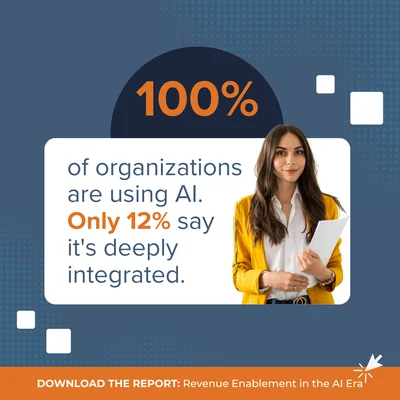
In fact, according to the Revenue Enablement in the AI Era report from LeadG2, The Center for Sales Strategy's RevOps division, 100% of organizations surveyed are either using or piloting AI.
Yet there's a significant gap between adoption and impact. Only 12% say AI is deeply integrated into their daily workflows.
That means most sales teams are still experimenting (testing prompts, trying new tools, and saving a few minutes here and there) but haven't figured out how to make AI a consistent part of how they sell.
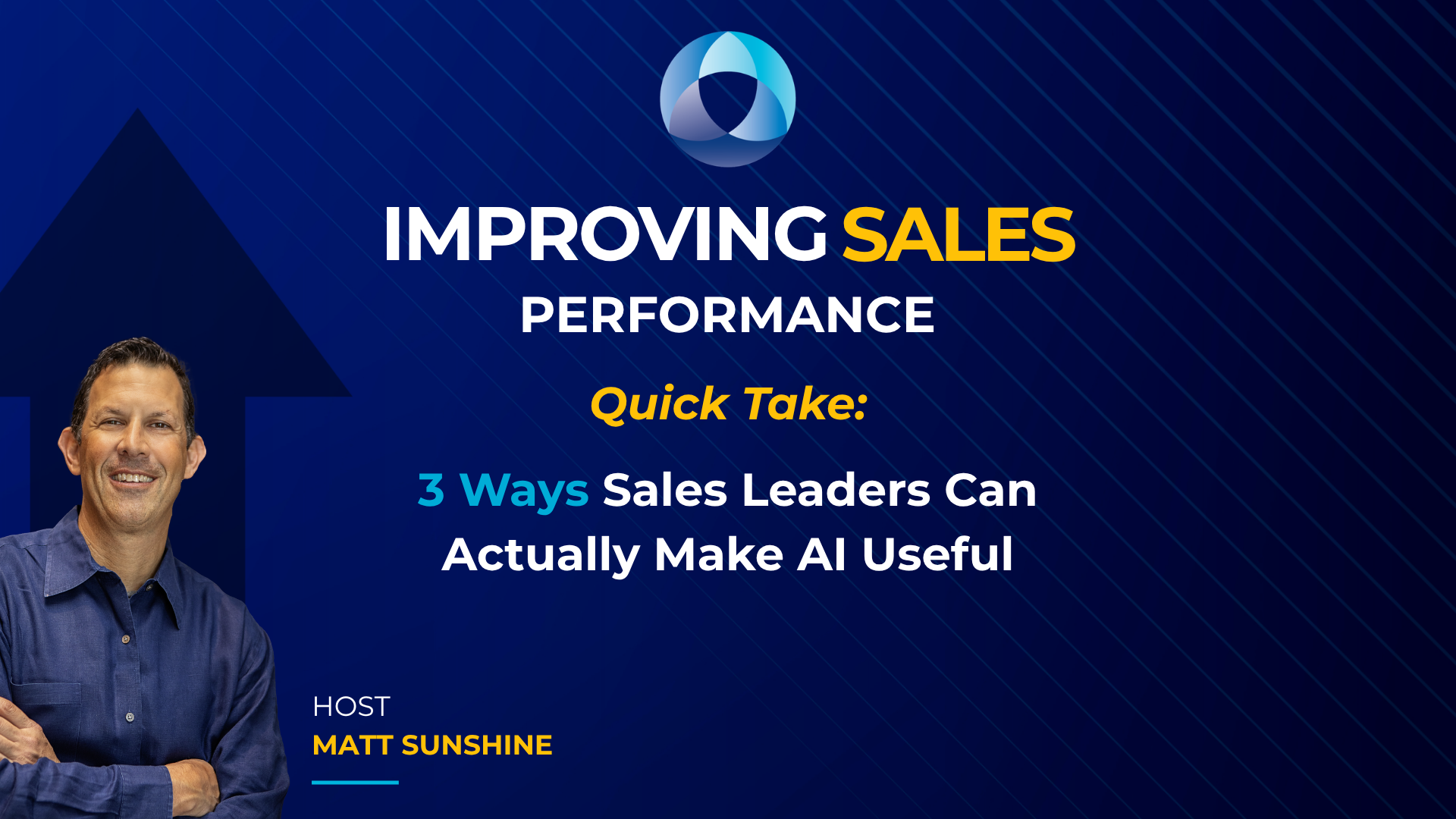
In this episode of Improving Sales Performance, Matt Sunshine, CEO of The Center for Sales Strategy, explains why AI alone won't improve sales performance (and what sales leaders can do to move from experimentation to execution).
The Short Answer: AI Doesn't Improve Sales Performance. Great Workflows Do.
The organizations seeing the greatest value from AI aren't simply using more tools. They're using AI more intentionally.
Instead of treating AI as a separate initiative, they're embedding it into existing workflows, coaching teams on practical applications, and strengthening the systems that AI depends on.
In other words, they're making AI part of how work gets done... not another item on the to-do list.
Why So Many Teams Stay Stuck in "Experiment Mode"
Trying AI is easy. Operationalizing AI is much harder.
Many organizations purchase new AI tools with the expectation that adoption will happen naturally. Unfortunately, that's rarely the case.
Without clear workflows, practical training, and consistent reinforcement, AI often becomes something people occasionally use rather than something they depend on.
The result?
Lots of experimentation. Very little transformation.
Three Ways Sales Leaders Turn AI into Everyday Value
1. Embed AI into Existing Workflows
One of the biggest mistakes organizations make is asking salespeople to stop what they're doing and "go use AI."
The highest-performing teams take a different approach.
They build AI into tasks reps already perform every day, including:
- Researching prospects before discovery calls
- Drafting personalized follow-up emails
- Summarizing meeting notes
- Identifying stalled opportunities
- Preparing account insights before customer conversations
According to LeadG2's research, 90% of organizations report that AI has improved efficiency, but most describe those improvements as incremental rather than transformational.
That's because AI delivers the greatest value when it removes friction, not when it creates another step.
2. Train Reps with Practical Use Cases
Buying AI software isn't the same as enabling people to use it effectively.
LeadG2's report found that lack of training and internal expertise was the number one barrier to AI adoption across every role surveyed.
The strongest sales leaders don't assume their teams will figure it out on their own.
Instead, they answer practical questions like:
- How can AI help me prospect more efficiently?
- How can it improve discovery preparation?
- How can it help me manage my pipeline?
- How can it help me sell more effectively?
The more relevant the use case, the more likely adoption becomes.
3. Strengthen the Systems Behind AI
AI amplifies whatever already exists.
If your CRM data is incomplete…
If your messaging is inconsistent…
If your sales process lacks clear playbooks…
AI won't solve those issues. It will simply scale them.
LeadG2's research found:
- 64% of respondents identified inconsistent messaging and playbooks as a significant challenge.
- Only 27% said they were very confident in the accuracy of their CRM and AI data.
Before AI can become a competitive advantage, organizations need strong fundamentals:
- Clean CRM data
- Consistent messaging
- Defined workflows
- Repeatable sales processes
- Ongoing coaching
Focus AI on Everyday Sales Moments
Many AI conversations focus on long-term transformation. Salespeople are focused on today's workload.
That's why the most successful AI strategies improve everyday activities such as:
- Preparing for meetings
- Personalizing outreach
- Coaching conversations
- Managing follow-up
- Increasing pipeline visibility
When AI helps salespeople perform better in the moments that happen every day, adoption becomes natural (and performance improves alongside it).
Turn AI into a Competitive Advantage
AI adoption is no longer the challenge.
Making AI genuinely useful is.
The strongest sales leaders don't chase the latest tools. They focus on building workflows, strengthening their sales systems, and coaching their teams to use AI in practical, repeatable ways that improve day-to-day execution.
If you're looking for more data, insights, and practical recommendations on how sales organizations are navigating AI adoption, download LeadG2's Revenue Enablement in the AI Era Report. It explores the latest research on AI usage, adoption barriers, and the strategies high-performing organizations are using to move beyond experimentation and create lasting impact.
Frequently Asked Questions
Why aren't most organizations seeing transformational results from AI?
Many companies are still experimenting with AI rather than integrating it into everyday sales workflows. Without practical adoption, the impact remains limited.
What's the biggest barrier to AI adoption?
According to LeadG2's Revenue Enablement in the AI Era report, the biggest obstacle is a lack of training and internal expertise, not a lack of technology.
Where should sales leaders start with AI?
Start with the repetitive, time-consuming tasks salespeople already perform. AI adoption increases when it makes existing work easier instead of introducing entirely new processes.
Can AI overcome weak sales processes?
No. AI amplifies existing systems. Organizations with clean CRM data, consistent messaging, defined workflows, and strong coaching habits are far more likely to realize meaningful value.

.png?width=2000&height=307&name=CSS_website%20footer_awards_2%20(1).png "CSS_website footer_awards_2 (1)")