
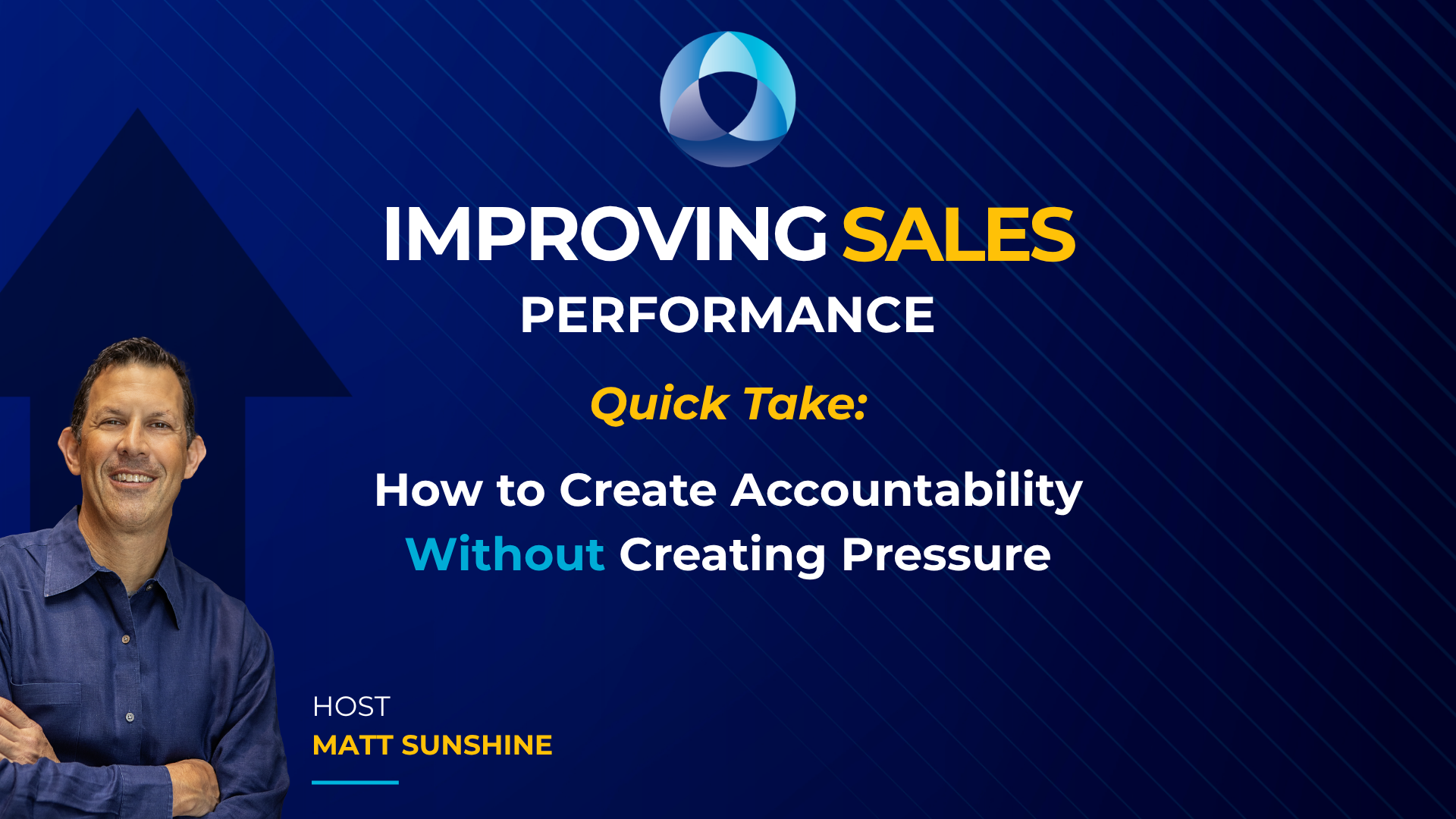
How can sales managers hold their teams accountable without creating unnecessary pressure?
It's one of the most difficult balancing acts in sales leadership.
Every manager wants their team to perform at a high level. But there's a fine line between creating accountability and creating anxiety.
Too much pressure can make salespeople defensive, hesitant, or afraid to ask for help. Too little accountability can lead to complacency and inconsistent performance.
In this episode of Improving Sales Performance, Matt explains how the best sales managers strike the right balance: challenging people to improve while creating an environment built on clarity, trust, and support.
The Short Answer: Accountability Creates Ownership. Pressure Creates Fear.
Accountability and pressure are often confused, but they produce very different outcomes.
Pressure leaves salespeople wondering if they're in trouble.
Accountability helps them understand what's expected, where they stand, and how they can improve.
The strongest sales managers don't lower expectations to reduce pressure. Instead, they create clear expectations, coach consistently, and support their team every step of the way.
Why Accountability Sometimes Feels Like Pressure
Many managers don't intend to create stress.
But accountability conversations can become uncomfortable when expectations are unclear or feedback only happens after something goes wrong.
Without consistency, every meeting starts to feel like bad news.
That's why top-performing managers focus on creating predictability rather than surprises.
When salespeople know what's expected and understand how success is measured, accountability becomes much more constructive.
Five Ways Great Sales Managers Create Accountability Without Pressure
1. Start with Clear Expectations
One of the fastest ways to reduce unnecessary pressure is to eliminate uncertainty.
Instead of saying: "You need to step it up."
Great managers are specific.
They explain:
- what success looks like
- which behaviors matter most
- how progress will be measured
Clarity creates stability, and stability makes accountability conversations far more productive.
2. Coach Behaviors, Not Just Results
Revenue matters. Quota matters. But managers have far more influence over behaviors than outcomes.
Rather than focusing exclusively on numbers, great managers coach the activities that produce those results, including:
- prospecting consistency
- discovery conversations
- follow-up habits
- pipeline management
- preparation
When managers coach behaviors, salespeople feel developed, not judged.
3. Make Accountability Collaborative
Sometimes the biggest difference isn't what managers say. It's how they say it.
Instead of asking:
"Why hasn't this deal closed?"
Try asking:
"What do you think is slowing momentum?"
Instead of telling someone to "fix this," ask:
"What support or adjustments would help?"
Collaborative language encourages ownership and problem-solving instead of defensiveness.
4. Coach Consistently
Pressure often builds when feedback only appears during difficult moments.
Top sales managers avoid this by creating predictable coaching rhythms:
-
Weekly one-on-ones.
-
Regular deal reviews.
-
Ongoing performance conversations.
When coaching becomes a normal part of the team's routine, accountability no longer feels threatening. Coaching simply becomes part of how the team operates.
5. Pair High Expectations with High Support
Strong accountability doesn't mean leaving people to figure everything out on their own.
The best managers communicate:
"Here's the expectation."
"Here's where improvement is needed."
"Here's how I'll help."
Support may include role-playing, deal strategy discussions, skill development, or help with prioritization.
The goal isn't to create dependence.
It's to give salespeople the confidence and tools they need to succeed.
Questions That Create Ownership
One of the most effective ways to build accountability is by asking thoughtful questions instead of immediately providing answers.
Questions like:
- What do you think needs to improve?
- What's the biggest obstacle right now?
- What's your plan moving forward?
- What support would help the most?
These conversations encourage reflection, critical thinking, and ownership.
Over time, salespeople become better at evaluating their own performance instead of relying on managers to solve every problem.
Better Accountability Leads to Better Performance
High-performing sales teams aren't built through pressure.
They're built through clarity, consistency, coaching, and trust.
When managers communicate expectations clearly, focus on behaviors, create regular coaching conversations, and support people as they grow, accountability becomes something salespeople value, not something they fear.
If you want stronger performance from your team, start by changing how accountability feels.
When it's done well, people don't shut down.
They step up.
Frequently Asked Questions
What's the difference between accountability and pressure?
Pressure creates fear and uncertainty. Accountability creates clarity, ownership, and a shared commitment to improvement.
Why do accountability conversations sometimes feel uncomfortable?
Often because expectations haven't been clearly communicated or feedback only happens when performance declines.
Should accountability focus on results or behaviors?
Both matter, but managers have the greatest influence over behaviors. Coaching those behaviors is what ultimately drives stronger results.
How can managers make accountability feel more supportive?
Be clear about expectations, coach consistently, ask collaborative questions, and pair high standards with meaningful support.


.png?width=2000&height=307&name=CSS_website%20footer_awards_2%20(1).png "CSS_website footer_awards_2 (1)")